
DeKalb County DUI Lawyer
Because we have experience as former DUI prosecutors and limit the number of cases we accept, the Hawkins Spizman team of DeKalb County DUI lawyers fights aggressively for our clients. We know that it isn’t just your freedom and driving privileges that are on the line, but your reputation, career, and future.
That means, for example, in DeKalb County, we do things differently than any other local DUI lawyer. We investigate the circumstances of the charges carefully, attack specific pieces of evidence, and analyze the legal strategies available to our clients on a personalized basis.
At the same time, if your case is pending in DeKalb County, our team of DeKalb County DUI lawyers will work to evaluate the evidence in your case and put a plan into action to defend the charges. Our attorneys work every day to maintain an excellent working relationship with prosecutors, judges, and law enforcement personnel throughout the state to get better results on the local level.
What all of this means to you is that you can hire the Hawkins Spizman team with confidence, knowing that we’ll do everything we can to represent your interests and protect your rights. Give us a call today for a free, no-obligation consultation.
GEORGIA DUI LAWS
Drivers in DeKalb County are prohibited from operating any motor vehicle while under the influence of alcohol. If you are of legal drinking age, a blood alcohol content (BAC) of .08 percent or more means that you are considered to be above the legal limit. If you are under the age of 21 or have a commercial driver’s license, the BAC limits are lower.
For under 21 drivers, Georgia has a Zero Tolerance policy, which means that any BAC above .02 percent is considered unlawful. For commercial drivers on the job, the legal limit is .04 percent.
Many people ask us how many drinks it takes to be considered legally impaired. The answer to this is difficult to come by. Every person is unique and metabolizes alcohol differently. This means that two drinks may affect one person differently than another.
In fact, you don’t have to be at or above the legal limit to be considered impaired. If a police officer believes alcohol consumption has affected your driving, even if it was just one beer, you could be arrested. Although it is not illegal to drink and drive, beware that it does not take much in this day and age to be arrested for DUI, even when you are not impaired.
CONSEQUENCES OF A DUI CONVICTION
If you are convicted of driving under the influence in DeKalb County, you potentially face stiff penalties.
-
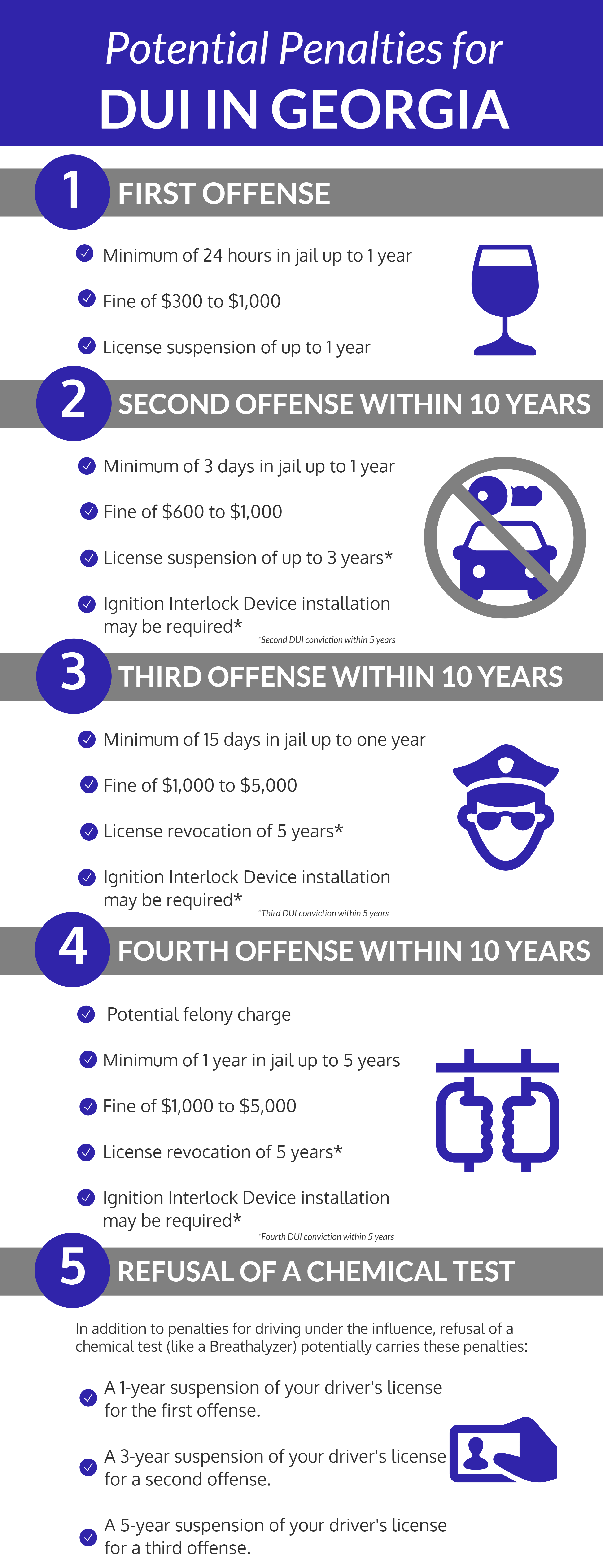
First offense: You face a minimum of 24 hours in jail up to one year, a fine of $300 to $1,000 and a license suspension of one year.
-
Second offense within 10 years: There is a minimum of 3 days in jail and a maximum of one year, you face a fine of $600 to $1,000 and a driver’s license suspension of up to three years.
-
Third offense within 10 years: For a third offense, you face a minimum of 15 days in jail and a maximum of one year, $1,000 to $5,000 in fines and a five-year license revocation.
-
Fourth offense within 10 years: This is a felony in Georgia, as of 2008.There is a minimum jail sentence of one year and a maximum of five years, a fine of $1,000 to $5,000 and your license could be revoked for 5 years.
When you are convicted of a second offense or higher within 10 years, you will also be required to install an interlock ignition device on your vehicle. The penalties could also be more severe if you have a very high BAC (above .15) at the time of arrest.
None of these consequences include the impact a conviction could have on your personal and professional life. You may find it difficult to maintain or find employment, suffer financial difficulties and tarnish your good reputation. If you hold any kind of professional license, such as for driving a commercial vehicle or for teaching, law, medicine, nursing, financial advising, it could be suspended or revoked altogether after a DUI.
WHAT IF YOU REFUSED A CHEMICAL TEST?
It is not unusual for people charged with driving under the influence to believe that prosecutors have no evidence against them when they refused to take a chemical test, like a breathalyzer. This may not be true.
Additionally, the refusal of a chemical test carries additional consequences. DeKalb County is an implied consent state, meaning that you consent to a request for a chemical test if charged with DUI when you use the roadways of this state.
If you have refused a chemical test, you potentially face:
- A one year suspension of your driver’s license for the first offense.
- A three year suspension of your driver’s license for a second offense.
- A five year suspension of your driver’s license for a third offense.
These consequences are in addition to any you are given for a conviction of driving under the influence.
HOW A DEKALB COUNTY DUI ATTORNEY CAN HELP
If you have been charged with driving under the influence, having an experienced lawyer by your side is vital. An attorney can help to mitigate the consequences of a conviction and, in some cases, have your charges reduced or eliminated.
DeKalb County DUI attorney Michael Hawkins has been named as a Super Lawyer 15 times by Atlanta Magazine. He is AV-rated by Martindale-Hubbell, achieving the highest possible score for both ability and ethics, and is one of only four board certified DUI defense lawyers in the state of Georgia. He is the only DeKalb County DUI defense lawyer to be named in both the Best Lawyers in America directory and honored by the Celebration of Legal Excellence. His work has even been featured in US News & World Report.
What do these awards and honors mean to you? It means that when you work with the team at Hawkins Spizman, you can be sure that the DUI lawyer in DeKalb County you meet with have a sterling reputation with clients, judges, law enforcement, and even other attorneys whether you were charged in DeKalb County or any surrounding area. You know that you’re getting the best representation because we have the qualifications and background to prove it.
If your case is pending anywhere in the DeKalb County area, there are a lot of places you can turn for a DUI attorney. But working with Hawkins Spizman can give you the best possible chance of a positive outcome when your case goes to court.
The Cancer Survivor Scholarship
We are excited to announce our 2019 Cancer Survivor Scholarship. Our goal is to help support students who have endured cancer directly or were directly impacted by the cancer diagnosis of a family member or close friend. Please visit our scholarship page to learn how you can apply for this $1,000 award.
